Medieval India: Rulers and Buildings (NCERT)
Medieval India: Rulers and Buildings (NCERT)

Rulers and Buildings
Between the eighth and eighteenth centuries, rulers built forts, palaces, tombs, and other constructions. Temples, mosques, tanks, wells, caravanserais, and bazaars are examples of public buildings. Rulers aspired to gain the respect of their citizens by building facilities for their use and comfort. Others, especially merchants, were also involved in the construction process. Domestic architecture, on the other hand, such as huge homes (Havelis), dates only from the eighteenth century.
The Qutb Minar is a five-story structure with a band of Arabic inscriptions under the first balcony. Qutbuddin Aybak built the first level in 1199, and Iltutmish built the rest of it in 1229. It was devastated by lightning and earthquakes over time and was rebuilt by Alauddin Khalji, Muhammad Tughluq, Firuz Shah Tughluq, and Ibrahim Lodi.
Monuments
The rulers constructed a number of magnificent buildings and constructions. These are referred to as monuments. The status of monuments was conferred on two sorts of buildings erected by kings and their craftsmen:
-
Rulers' residences, such as forts, palaces, and gardens.
-
Temples, Mosques, Bazaars, and Wells are examples of public structures.
Engineering Skills and Construction
There were a lot of talented craftsmen before and they were needed to construct beautiful structures. They were capable to carve magnificent structures on monuments using technology that were beyond their wildest dreams.
Between the seventh and tenth centuries, artisans began to construct increasingly complex structures with more rooms, roofs, doors, and windows. Between the seventh and twelfth centuries, however, many temples, mosques, tombs, and structures linked to enormous stepping wells, sometimes known as baolis, were built in the trabeate style, which became popular at the period.
Buildings, Temples, Mosques, and Tanks
-
As temples and mosques were built as places of worship, they were designed to exhibit the patron's power, riches, and devotion.
-
All of the biggest temples were built by monarchs. The gods and goddesses of the ruler's allies and subordinates were the minor deities in the temples.
-
Although Muslim Sultans and Padshahs did not claim to be manifestations of God, the Sultan was referred to be the "Shadow of God" in Persian court chronicles.
-
King's tried to emphasize their moral right to govern with each new dynasty that came to power.
-
It was commonly assumed that a righteous king's reign would be a time of plenty, with the skies pouring down rain.
Why were Temples Destroyed?
When monarchs fought one another's kingdoms, they attacked and targeted temples to display their devotion to God as well as their strength and riches. When Chola monarch Rajendra I erected a Shiva temple in his capital in the early 11th century, he filled it with valuable sculptures stolen from defeated rulers.
Gardens, Tombs, and Forts
-
Architecture became more complicated during the Mughals. Literature, art, and architecture were personal interests of Babur, Humayun, Akbar, Jahangir, and Shah Jahan.
-
In Kabul, Babur had gardens named Chahar Bagh (4 gardens) constructed. Akbar, Jehangir, and Shah Jahan continued to build them in Kashmir, Agra, and Delhi.
-
The architecture of Akbar's father, Humayun, may be seen in his tomb.
-
The Mughal architecture was melded together in a magnificent harmonic harmony under Shah Jahan.
-
The public and private audience (diwan-i-Khas) ceremonial halls were meticulously constructed.
-
The TajMahal, Shah Jahan's most important architectural achievement, was laid out using the Chahar Bagh method.
Region and Empire
-
Between the eighth and eighteenth centuries, as construction activity increased, there was a significant exchange of ideas between regions.
-
The architecture of the Vijayanagar kings' elephant stables, for example, was heavily influenced by that of the neighboring Sultanates of Bijapur and Golconda.
-
The temple was built in Vrindavan, near Mathura, in architectural styles similar to those seen in Fatehpur Sikri's Mughal palaces.
-
Cross-fertilization of creative forms and architectural styles was helped by the formation of huge empires that reigned over many nations.
-
In their architecture, the Mughals borrowed the ‘Bangla dome.'
List of Rulers and Buildings in India
The list of rulers and buildings in India and also a list of famous historical monuments in India is as follows.
-
Agra Fort : The Agra Fort was a strategic location and a power hub that was utilized to command all of India. The precise date of the first fort's construction is unclear. The fort was built by the Mughals in its current shape. To some extent, all Mughal rulers were involved in the creation of the current structural shape. The fort was originally known as Badalgarh, and it was controlled by Raja Badal Singh, a Rajput ruler, in the year 1475. However, the Lodi dynasty of Delhi took possession of this fort. The first Delhi Sultan, Sikandar Lodi, relocated his capital from Delhi to Agra and occupied the Agra Fort.
-
Buland Darwaza : Akbar constructed Buland Darwaza in 1576 to commemorate his victory over Gujarat. Buland Darwaza is the world's tallest entry gate of its kind. This is the most well-known example of Mughal architecture. This structure may be seen at Fatehpur Sikri's main entrance. This structure is made of red sandstones and is embellished with marble in important spots. The gate's whole construction rises 54 meters above ground level. To get to the main platform where the gate is erected, you must climb 42 stairs. The gate itself is 40 meters tall from the foundation platform.
-
Char Minar : Hyderabad's Charminar is a symbol of the city. It was built by Quli Qutub Shah in the year 1591. It is essentially a mosque located on the Musi River's banks. According to tradition, Char Minar was built to commemorate the elimination of the dreadful plague epidemic that was posing a serious threat to the city. Quli Qutub Shah prayed and promised that if the disease was cured, he would build the memorial. Around this monument, Quli Qutub Shah established the city of Hyderabad. The architecture of this structure bears a Persian influence. The construction is square and 20 meters long, with a minaret at each corner. Each minaret is 56 meters tall.
-
Golden Temple (Harmandir Sahib) : Harmandir Sahib, also known as the Golden Temple, is a Hindu shrine in Amritsar, Punjab, India. This temple is one of the holiest Sikh temples on the planet. Guru Arjan, the fifth Sikh Guru, began work on the temple in 1585 and finished it in 1604. Jassa Singh Ahluwalia erected the current building, which is a Gurudwara, in 1764. Maharaja Ranjit Singh was the one who had the outside walls and top of the Golden Temple coated in gold, thus the name. Devotees bathe in the holy water of the reservoir that surrounds the temple and is supplied by the river Ravi.
-
Gol Gumbaz : Mohammad Adil Shah and his two wives are buried in Gol Gumbaz. This gumbaz is in the Karnataka city of Bijapur. The building is a massive dome, the world's second-largest of its sort (the first one is Hagia Sofia of the byzantine empire, presently in Turkey). When Adil Shah was still alive, the architect Yaqut of Dabul built this for him. The construction is made up of four minarets on each of the four corners of a central dome that stands on a cubical foundation. The base's sides are 47.5 meters long, while the dome's diameter is 44 meters. From the inside, the minarets are seven stories tall and octagonal, with a stairway leading to the high dome construction.
-
Qutub Minar : Qutub Minar is India's second-highest minaret (the tallest being Fateh Burj in Mohali, Punjab), as well as the world's tallest brick minaret. This minar may be seen in the Mahrauli neighborhood of Delhi, India. Qutub-ud-Din Aibak, who is also the founder of the Delhi Sultanate, built this minar. In addition, Qutub Minar is a UNESCO World Heritage Site in India. Red sandstones and marbles make up the construction. The minar's overall height is 73 meters (240 feet), with a diameter of 47 feet at the base and 9 feet at the top. There are 379 steps from the bottom to the summit. Iltutmish afterward erected three more floors in the year 1220 CE.
-
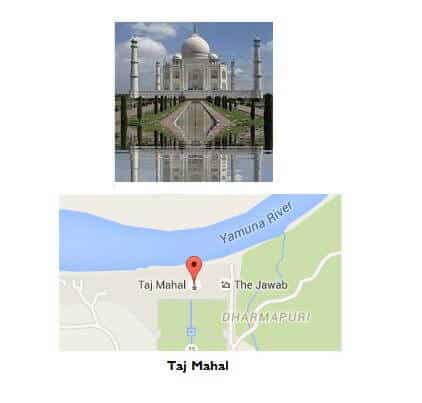
Taj Mahal : The Taj Mahal was designed by Mughal Emperor Shah Jahan, who is also known as the Mughal Architect. He also constructed several other structures, including the Red Fort in Delhi, the Jama Masjid in Delhi, the Moti Masjid in Lahore, and the Shalimar Gardens in Kashmir. He erected this monument as a loving homage to her late wife Mumtaj. The Taj Mahal's construction began in 1632 and was finished in 1653. It was constructed with the help of 20,000 workers and architect Ustad Ahmad Lahauri. At the time, the building cost was anticipated to be around 32 million rupees.
-
Hawa Mahal : The building of the Hawa Mahal was completed in 1799 by Sawai King Pratap Singh. The red and pink sandstone used in the building of the palace was designed by Ustad Lal Chand. The Hawa Mahal has become a distinctive picture and iconic depiction of Jaipur's pink city. This palace is shaped like Krishna's crown and is known for the honeycomb structure of its many windows.
-
Jantar Mantar : Maharaja Jai Singh of Jaipur erected a total of 5 Jantar Mantar in Jaipur. New Delhi, Mathura, Jaipur, Ujjain, and Varanasi are the locations of these Jantar Mantars. The Jantar Mantar in Jaipur is the largest and holds the world's largest stone Sundial, as well as being designated as a UNESCO World Heritage Site. These Jantar Mantar are essentially astronomical observatories that house a variety of astronomical instruments. These gadgets use the location of the sun in the sky to determine the time of day.
Conclusion
Thus, in order to conclude we can say that Kings and commanders have erected forts, palaces, and tombs since the ancient and medieval times. Domestic architecture, such as merchants' massive mansions (Havelis), is just a few centuries old. During the Mughals, architecture grew increasingly complex. Babur, Humayun, Akbar, Jahangir, and Shah Jahan were all passionate about literature, art, and architecture. There was a substantial interchange of ideas across areas between the ninth and eighteenth centuries.
Rulers and Buildings – Medieval India
- Between the 8th and the 18th centuries kings and their officers built two kinds of structures: First were forts, palaces and tombs. Second were structures meant for public activity including temples, mosques, tanks, wells, bazaars.
- By making structures for subjects’ use and comfort, rulers hoped to win their praise.
- Construction activity was also carried out by others, including merchants. However, domestic architecture – large mansions (havelis) of merchants – has survived only from the eighteenth century.
Engineering Skills and Construction
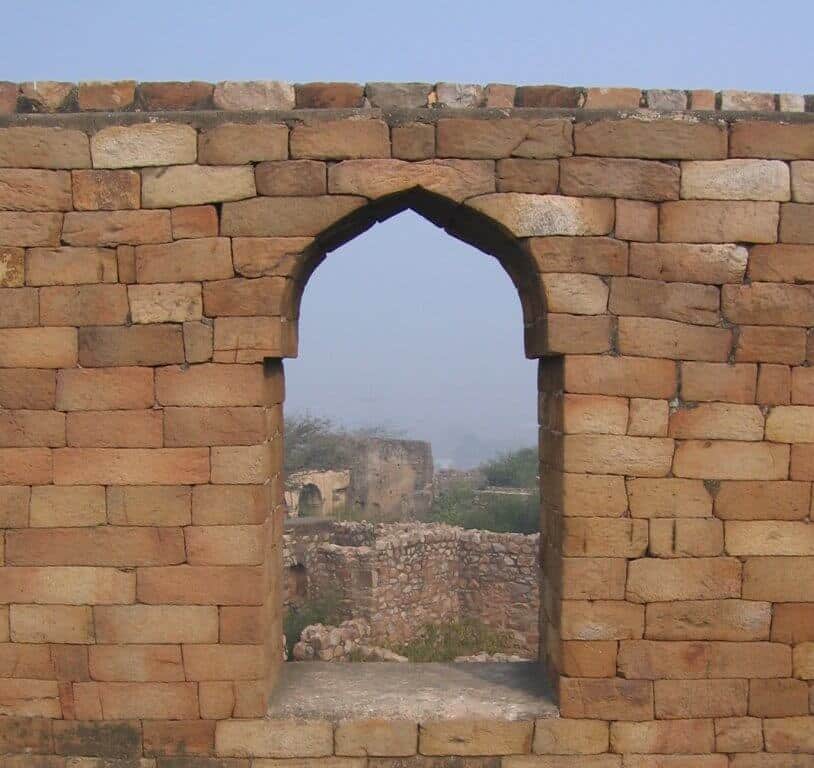
- Monuments provide an insight into the technologie used for construction.
- Between the 7th and 10th centuries architects started adding more rooms, doors and windows to buildings using “trabeate” or “corbelled” design.
- Corbelled: roofs, doors and windows were made by placing a horizontal beam across two vertical columns.
From the 12th century onwards certain changes were visible .
- “Arcuate“ type design started to appear. Here the weight of the superstructure above doors and windows was carried by the arches . The “keystone” at the centre of the arch transferred the weight of the superstructure to the base of the arch.
- Limestone cement was increasingly used in construction. This was very high quality cement .
Building Temples, Tanks and Mosques
- Hindu rulers took gods’ name. Eg: Rajarajeshvara temple was built by King Rajarajadeva for the worship of his god, Rajarajeshvaram.
- Muslim Sultans and Padshahs did not claim to be incarnations of god but Persian court chronicles
described the Sultan as the “Shadow of God”. - Water availability: Sultan Iltutmish [13th century] won respect for constructing a large reservoir just outside Dehli-i kuhna. It was called the hauz-i Sultani or the “King’s Reservoir”.
Religious construction: Why were temples constructed and destructed?
- As each new dynasty came to power, kings/emperors wanted to emphasise their moral right to be rulers.
- So constructing places of worship provided rulers with the chance to proclaim their close relationship with God, especially important in an age of rapid political change.
- Because kings built temples to demonstrate their devotion to God and their power and wealth, it is not surprising that when they attacked one another’s kingdoms, they often targeted these buildings. (Eg: Pandyan king Shrimara Shrivallabha, Chola king Rajendra I, Sultan Mahmud of Ghazni etc.)
Gardens, Tombs and Forts
- Under the Mughals, architecture became more complex.
- During Babur reign formal gardens, placed within rectangular walled enclosures and divided into four quarters by artificial channels. These gardens were known as chahar bagh, four gardens.
- The central towering dome and the tall gateway (pishtaq) became important aspects of Mughal architecture, first visible in Humayun’s tomb.
- Associated with the chahar bagh there was tradition known as “eight paradises” or hasht bihisht – a central hall surrounded by eight rooms.
- During Shah Jahan’s reign that the different elements of Mughal architecture were fused together in a harmonious synthesis. The ceremonial halls of public and private audience (diwan-i khas or am) were carefully planned. These courts were also described as chihil sutun or forty-pillared halls, placed within a large courtyard.
- Shah Jahan’s audience halls were specially constructed to resemble a mosque. The pedestal on which his throne was placed was frequently described as the qibla, the direction faced by Muslims at prayer.
- The connection between royal justice and the imperial court was emphasised by Shah Jahan in his newly constructed court in the Red Fort at Delhi.
- Court in Redfort by Shahjahan got a series of pietra dura [a Roman Art by inlaying of pieces of coloured stones resulting into some images] inlays that depicted the legendary Greek god Orpheus playing the lute[a string instrument]
- The construction of Shah Jahan’s audience hall aimed to communicate that the king’s justice would treat the high and the low as equals where all could live together in harmony.
- Shah Jahan adapted the river-front garden [a variation of chahar bagh] in the layout of the Taj Mahal.
- Only specially favoured nobles were given access to the river. All others had to construct their homes in the city away from the River Yamuna.
Region and Empire
- There was also a considerable sharing of ideas across regions: the traditions of one region were adopted by another. In Vijayanagara, for example, the elephant stables of the rulers were strongly influenced by the style of architecture found in the adjoining Sultanates of Bijapur and Golcunda.
- In Vrindavan, near Mathura, temples were constructed in architectural styles that were very
similar to the Mughal palaces in Fatehpur Sikri. - Mughal rulers were particularly skilled in adapting regional architectural styles in the construction of their own buildings.
Join us, follow us....
Follow on Telegram – Click Here
Follow Whats apps Channel – Click Here
Join Google News Group – Click Here