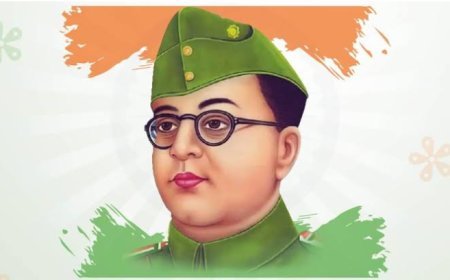
Dr. B.R Ambedkar: The conscience keeper of modern India
B.R. Ambedkar Biography: B.R Ambedkar jayanti is observed on April 14. He was known as Babasaheb. He chaired the drafting committee of the Constituent Assembly. He was India's first Minister of Law and Justice. Read more about his early life, education, political career, the Poona Pact, books written by him, and more.

Dr. B.R Ambedkar Biography
| Full Name | Bhimrao Ramji Ambedkar |
| Born | 14 April 1891 |
| Place of Birth | Mhow, India |
| Died | 6 December 1956 |
| Place of Death | New Delhi, India |
| Resting place | Chaitya Bhoomi, Mumbai, India |
| Parents |
Father: Ramji Maloji Sakpal
Mother: Bhimabai Sakpal
|
| Spouse(s) | Ramabai Ambedkar (m. 1906; died 1935) Savita Ambedkar (m. 1948) |
| Political party | Independent Labour Party Scheduled Castes Federation |
| Other political affiliations |
Republican Party of India |
| Alma mater | University of Mumbai (B.A., M.A.) Columbia University (M.A., PhD) London School of Economics (M.Sc., D.Sc.) Gray's Inn (Barrister-at-Law) |
| Profession | Jurist, economist, academic, politician, social reformer, and writer |
| Awards | Bharat Ratna (posthumously in 1990) |
| Known for or Famous for | Dalit rights movement Heading committee drafting Constitution of India Dalit Buddhist movement |
The early life of B.R Ambedkar
Born into the Hindu Mahar caste, which was scorned as “untouchable” by the upper class of the time, Babasaheb did not allow the limitations of his background to come in the way of acquiring first-rate education and pushing the bar for academic excellence. He earned a law degree from Lincoln’s Inn and doctorates from Columbia University in the US and the London School of Economics, carving a place of eminence as a scholar extraordinaire for his research in law, economics, and political science. His early career saw him donning many hats: economist, professor, and lawyer.
Ambedkar was born on 14 April 1891 in the town and military cantonment of Mhow (now officially known as Dr Ambedkar Nagar) (now in Madhya Pradesh).
Ambedkar’s ancestors had long worked for the army of the British East India Company, and his father served in the British Indian Army at the Mhow cantonment.
He faced casteism as a child during his school years- he and other such children weren’t allowed to sit inside the class.
Ambedkar was a bright child and excelled in his studies. In 1907, he passed his matriculation examination and in the following year, he entered Elphinstone College, which was affiliated with the University of Bombay, becoming, according to him, the first from his Mahar caste to do so.
By 1912, he obtained his degree in economics and political science from Bombay University and was prepared to take up employment with the Baroda state government.
In 1913, at the age of 22, Ambedkar was awarded a Baroda State Scholarship for three years under a scheme established by Sayajirao Gaekwad III (Gaekwad of Baroda) that was designed to provide opportunities for postgraduate education at Columbia University in New York City.
In 1916, he passed his second M.A and later completed his Ph.D. in economics from Columbia in 1927.
Even after being highly educated, the issue of untouchability issues his life in India after his return. He was unsuccessful at various jobs, even as a professor due to others objecting to his lower caste.
Dr. B. R Ambedkar Biography: Political Career
Dr. B.R Ambedkar was appointed principal of the Government Law College, Bombay in 1935. It was a position that was held for two years.
He served as the chairman of the governing body of Ramjas College, University of Delhi, after the death of its founder, Shri Rai Kedarnath. On October 13, at the Yeola Conversion Conference, Ambedkar in Nasik, announced his intention to convert to a different religion and encouraged his followers to leave Hinduism. Dr. B.R. Ambedkar founded the Independent Labour Party in 1936, which contested the Bombay election in 1937 to the Central Legislative Assembly for the 13 reserved and 4 general seats. It secured 11 and 3 seats, respectively.
On May 15, 1936, he published his book, The Annihilation of Caste. During this time, he also fought against the Khoti system that was prevalent in Konkan. Here, "khots" means government revenue collectors who regularly exploit farmers and tenants. In the Bombay Legislative Assembly, Ambedkar tabled a bill in 1937 with the purpose of abolishing the khoti system by generating a direct relationship between the government and farmers.
As a minister of labour, he served on the Defence Advisory Committee and the Viceroy's Executive Council. In 1940, after the Lahore Resolution of the Muslim League demanding Pakistan, he wrote a 400-page tract titled "Thoughts on Pakistan," which analysed the concept of "Pakistan" in all its aspects. His work, Who Were the Shudras? Babasaheb tried to explain the formation of the untouchables. His political party was transformed into the Scheduled Castes Federation. It performed poorly in the 1946 elections for the Constituent Assembly of India. Later, Babasaheb was elected to the constituent assembly of Bengal, where the Muslim League was in power.
In 1952, he contested in Bombay North's first Indian General Election but lost. He became a member of the Rajya Sabha, basically an appointed member. In the 1954 by-election from Bhandara, he attempted to re-enter the Lok Sabha, but he placed third. And by the time of the second general election in 1957, Babasaheb died.
Ambedkar’s fight against untouchability
In the next stage, he emerged as a national leader with a pan-India vision of modernity underpinned by the ideals of social justice and equality. As India’s freedom movement gained traction, he harnessed his formidable intellectual energies to script an anthem of an inclusive India and strove tirelessly for political rights and social freedom for Dalits and marginalized groups.
In 1923, he set up the’Bahishkrit Hitkarini Sabha (Outcastes Welfare Association)’, which was devoted to spreading education and culture amongst the downtrodden.
By 1927, Ambedkar had decided to launch active movements against untouchability. He began with public movements and marches to open up public drinking water resources.
He also began a struggle for the right to enter Hindu temples.
In a conference in late 1927, Ambedkar publicly condemned the classic Hindu text, the Manusmriti (Laws of Manu), for ideologically justifying caste discrimination and “untouchability”, and he ceremonially burned copies of the ancient text.
Poona Pact, 1932:
In 1932, the British colonial government announced the formation of a separate electorate for “Depressed Classes” in the Communal Award. Mahatma Gandhi fiercely opposed a separate electorate for untouchables, saying he feared that such an arrangement would divide the Hindu community.
Gandhi protested by fasting while imprisoned in the Yerwada Central Jail of Poona. Following the fast, congressional politicians organized joint meetings with Ambedkar and his supporters at Yerwada.
On 25 September 1932, the agreement, known as the Poona Pact was signed between Ambedkar (on behalf of the depressed classes among Hindus) and Madan Mohan Malaviya (on behalf of the other Hindus).
The agreement gave reserved seats for the depressed classes in the Provisional legislatures within the general electorate.
The text used the term “Depressed Classes” to denote Untouchables among Hindus who were later called Scheduled Castes and Scheduled Tribes under the India Act 1935 and the later Indian Constitution of 1950.
Maker and conscience-keeper of modern India
Babasaheb, as he was fondly called by friends, admirers, and followers, braved the walls of prejudice and caste discrimination in early 20th century India to emerge as an exemplar and an unflinching crusader against the inequities of the caste system and socio-economic deprivation that afflicted millions of Indians.
His life is an inspirational story of achievements despite trying circumstances and the indomitable will to move beyond individual strife for the larger cause of social justice and national renaissance.
The drafting of India’s constitution:
India’s tryst with destiny, as India’s first Prime Minister Jawaharlal Nehru spoke eloquently about at the fateful hour of India’s independence, saw Dr. Ambedkar being entrusted with a monumental responsibility: he was appointed Chairman of the Constitution Drafting Committee on August 29, 1947.
He fashioned a pluralistic and inclusive Constitution that guides and animates India to this day, guaranteeing equal opportunity and freedom of expression and faith for all citizens in a secular democracy.
Famous scholar Granville Austin has evoked the revolutionary spirit of Dr. Ambdekar that is reflected in the Indian Constitution. “The majority of India’s constitutional provisions are either directly arrived at furthering the aim of social revolution or attempt to foster this revolution by establishing conditions necessary for its achievement,” wrote Austin.
The Constitution, drafted under Dr. Ambedkar’s leadership, abolished untouchability and outlawed all forms of discrimination.
An ardent proponent of the rights of women, minorities, and the socially underprivileged, he argued eloquently and won the Constituent Assembly’s support for introducing a system of reservations of jobs in the civil services, schools, and colleges for members of Scheduled Castes, Scheduled Tribes, and Other Backward Class.
This was later reflected in the policies of affirmative action adopted by the Indian government.
An erudite economist and institution-builder, Dr. Ambedkar authored many scholarly treatises on economics and was the driving force behind the establishment of the Finance Commission of India. His ideas also laid the foundation for the setting up of India’s central bank, the Reserve Bank of India.
While Dr. Ambedkar’s achievements were manifold and straddled a wide spectrum, his inner life was richer and marked by spiritual vitality. In 1956, he converted to Buddhism.
Death:
He died in 1956 in New Delhi while working on “The Buddha and his Dhamma”, which was published posthumously.
The popularity and esteem he enjoyed among all lovers of social justice were seen at his funeral at Dadar Chowpatty beach on December 7, 1956, which was thronged by at least half a million mourners.
Legacy of Babasaheb Ambedkar
Babasaheb’s myriad contributions to the forging of a modern inclusive India were recognized posthumously through the Bharat Ratna in 1990.
Dr. Ambedkar’s ideals of social inequality redesigned the contours of Indian politics. His surging popularity was reflected in scholarly biographies, numerous statues, and memorials across the country.
Today, Ambedkar is revered nationally, and figures in the national pantheon as one of the makers of modern India, along with Gandhi, Nehru, and Tagore.
His birthday, April 14, has been christened ‘Ambedkar Jayanti’ or ‘Bhim Jayanti’ and is celebrated as a public holiday.
As India celebrates the birth anniversary of this national icon, Babasaheb remains an inspiration for millions of Indians and proponents of equality and social justice across the globe.
Fittingly, although it’s a matter of coincidence, one can see the trace of Babasaheb’s radiant vision in the “Sustainable Development Goals” that are set to be formally adopted by the UN General Assembly to eliminate poverty, hunger, and socio-economic inequality by 2030.
Books by Ambedkar
- The Problem of the Rupee – Its origin and its solution
- The Untouchables, Who are they?
- Who were the Shudra?
- States and Minorities
- Emancipation of the Untouchables
Essential Facts About B.R Ambedkar
Fact 1
Dr. B.R Ambedkar's actual name is Ambadvekar. He was born into a Mahar caste family, who were considered untouchables and faced socio-economic discrimination in Madhya Pradesh.
Fact 2
In 1955, he proposed the division of Bihar and Madhya Pradesh, a suggestion that was implemented 45 years later.
Fact 3
Dr. Ambedkar was Independent India's first law minister. He resigned from his position when his bill advocating women's rights was opposed in Parliament.
Fact 4
Despite contesting in the 1952 and 1954 elections, he was never victorious.
Fact 5
On November 27, 1942, during the 7th session of the Indian Labour Conference in New Delhi, he raised the issue of working hours. This led to a reduction in working hours in India from 14 to 8 hours.
Fact 6
Dr. Ambedkar was the first Indian to pursue a doctorate degree in economics abroad.
Fact 7
Dr. B.R Ambedkar was responsible for formulating several laws for Women Labours in India:
- Mines Maternity Benefit Act
- Women Labor welfare fund
- Women and Child, Labor Protection Act
- Maternity Benefit for women Labor
- Restoration of Ban on Employment of Women on Underground Work in Coal Mines
Fact 8
Dr. Ambedkar's Ph.D. thesis, "The Evolution of Provincial Finance in British India", written in 1923, has been a unique reference source for all the 13 Finance Commission reports.
Fact 9
Dr. B.R Ambedkar enacted numerous laws for the welfare of the people.
- Dearness Allowance (DA) to Workers
- Leave Benefit to Piece Workers
- Revision of Scale of Pay for Employees
- Health Insurance Scheme
- National Employment Agency (Employment Exchange)
- Employees State Insurance (ESI)
- Provident Fund Act
- Factory Amendment Act
- Labor Disputes Act
- Minimum wage
Fact 10
He enacted the Coal Mines Safety (Stowing) Amendment Bill and the Mica Mines Labor Welfare Fund for the benefit of the workers.
Fact 11
Dr. Babasaheb Ambedkar passed the Indian Statistical Act in 1942.
Fact 12
Dr. Babasaheb Ambedkar also contributed to the development of water resources. He designed and planned the Damodar Valley Project, Hirakud project, and the Sone River valley project.
Fact 13
The Reserve Bank of India (RBI) was established based on the ideas presented by Ambedkar to the Hilton Young Commission.
Fact 14
On October 14, 1956, he converted to Buddhism at Deekshabhumi (Nagpur), an event known as Dhamma Chakra Pravartan Din.
Fact 15
Chaitya Bhoomi, where Dr. B R Ambedkar was cremated following his death on December 6, 1956, is a memorial site dedicated to him. This day is observed as Mahaparinirvan Din.
Join us, follow us....
Follow on Telegram – Click Here
Follow Whats apps Channel – Click Here
Join Google News Group – Click Here