Subhas Chandra Bose: Biography of Netaji
Netaji Subhas Chandra Bose Biography: He is an Indian Nationalist whose patriotism towards India has left a mark in the hearts of many Indians. On Netaji's birth anniversary, let us read more about him.
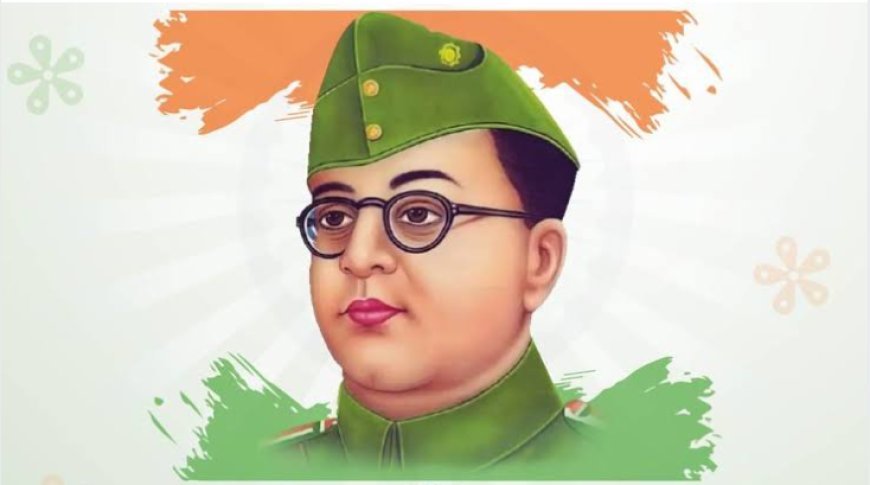
Netaji Subhas Chandra Bose Biography: Netaji Subhas Chandra Bose was an Indian Nationalist whose patriotism towards India has left a mark in the hearts of many Indians. He is famously known as the founder of 'Azad Hind Fauj' and his famous slogan is 'Tum Mujhe Khoon Do, Main Tumhe Aazadi Dunga'. Today we are celebrating his 126th Birth Anniversary as Parakram Diwas.
Netaji Subhas Chandra Bose was born on 23 January,1897 in Cuttack, Orissa and he died on 18 August,1945, in a hospital in Taiwan after suffering from burn injuries sustained in a plane crash.
Subhas Chandra Bose is considered the most influential freedom fighter with extraordinary leadership skills and a charismatic orator. His famous slogans are 'tum mujhe khoon do, main tumhe aazadi dunga', 'Jai Hind', and 'Delhi Chalo'. He formed Azad Hind Fauj and made several contributions to India's freedom struggle. He is known for his militant approach that he used to gain independence and for his socialist policies.
| Name | Subhas Chandra Bose |
| Date of Birth | January 23, 1897 |
| Place of Birth | Cuttack, Odisha |
| Parents |
Janakinath Bose (father)
Prabhavati Devi (mother)
|
| Spouse | Emily Schenkl |
| Children | Anita Bose Pfaff |
| Education | Ravenshaw Collegiate School, Cuttack; Presidency College, Calcutta; University of Cambridge, England |
| Associations(Political Party) | Indian National Congress; Forward Bloc; Indian National Army |
| Movement | Indian Freedom Movement |
| Political Ideology | Nationalism; Communism; Fascism-inclined |
| Religious Beliefs | Hinduism |
The early life of Netaji Subhas Chandra Bose
Birth and family:
Subhas Chandra Bose was born on January 23, 1897, in Cuttack, Orissa.
His father Janaki Nath Bose was a famous lawyer and his mother’s name was Prabhavati Devi.
He was the ninth child among fourteen siblings.
Education:
Subhas Chandra Bose topped the matriculation examination of Calcutta province and graduated with a First Class in Philosophy from the Scottish Churches College in Calcutta.
He was very patriotic and deeply influenced by Swami Vivekananda’s teachings as a student.
He went to England in 1919 to compete for Indian Civil Services. In England, he appeared for the Indian Civil Service competitive examination in 1920 and came out fourth in order of merit.
However, Subhas Chandra Bose left his Civil Services apprenticeship midway to return to India in 1921 as he was deeply disturbed by the Jallianwalla Bagh massacre.
Subhas Chandra Bose and Indian National Congress
He joined the Non-Cooperation Movement which was started by Mahatma Gandhi who made INC a powerful non-violent organization. During the movement, he was advised by Mahatma Gandhi to work with Chittaranjan Das who became his political guru. After that, he became a youth educator and commandant of the Bengal Congress volunteers. He started the newspaper 'Swaraj'. In 1927, after being released from prison, Bose became general secretary of the Congress party and worked with Jawaharlal Nehru for independence.
In 1938 he was elected president of the Indian National Congress and formed a national planning committee, which formulated a policy of broad industrialization. However, this did not harmonize with Gandhian economic thought, which clung to the notion of cottage industries and benefiting from the use of the country’s own resources. Bose’s vindication came in 1939 when he defeated a Gandhian rival for reelection. Nonetheless, the “rebel president” felt bound to resign because of the lack of Gandhi’s support.
Subhas Chandra Bose and the formation of Forward Bloc
All India Forward Bloc was a left-wing nationalist political party in India that emerged as a faction within the India Congress in 1939, led by Subhas Chandra Bose. He was well known for his leftist views in Congress. The prime objective of the Froward Bloc was to bring all radical elements of the Congress party. So that he could spread the meaning of complete independence of India with adherence to the application of principles of equality and social justice.
The political life of Netaji Subhas Chandra Bose
On his return to India, he came under the influence of Mahatma Gandhi and joined the Indian National Congress.
On Gandhiji’s instructions, he started working under Deshbandhu Chittaranjan Das, whom he later acknowledged as his political guru.
1923: Subhas Chandra Bose was elected the President of All India Youth Congress and also the Secretary of Bengal State Congress. He was also the editor of the newspaper ‘Forward’, founded by Chittaranjan Das.
1924: He also served as the CEO of the Calcutta Municipal corporation when Das was the mayor of Calcutta.
1925: He was arrested and sent to prison in Mandalay, where he contracted tuberculosis.
1927: He was released from prison, and later became the general secretary of the Congress party.
1928: The Motilal Nehru Committee appointed by the Congress declared in favour of Domination Status, Subhas Chandra Bose and Jawaharlal Nehru opposed it. They both asserted that only complete independence for India was acceptable.
Bose also announced the formation of the Independence League.
1930: Subhas Chandra Bose was jailed during the Civil Disobedience Movement. He later became the Mayor of Calcutta.
1931: Bose was released after the Gandhi-Irwin pact was signed. He protested against the Gandhi-Irwin pact and the suspension of the Civil Disobedience movement especially when Bhagat Singh and his associates were hanged.
He travelled through Europe after this, establishing centres in different European capitals to promote politico-cultural contacts between India and Europe.
1937: He returned to India and was released after Congress won the general elections.
Subhas Chandra Bose as President Of Indian National Congress Sessions
1938: He was elected President of the Haripura Congress Session (Gujarat), during this term as Congress President; he talked of planning and setting up a National planning Committee in October that year.
1939: He also won the presidential election to the Tripuri Congress session, defeating Dr. Pattabhi Sitaramayya who had been backed by Mahatma Gandhi and the Congress Working Committee.
This led to the Tripuri Crisis in Congress due to ideological differences between Bose, who had strong leftist thinking and older leaders who were more right-wing thinkers.
As a result, Bose resigned and formed the ‘Forward Bloc’, the left-wing party within the Congress at Unnao in U.P.
1940: When INC organized Individual Satyagraha, Subash Chandra Bose organized an ‘Anti-Compromise Conference’ at Ramgarh, Bihar.
He was arrested by the British shortly afterwards for organizing a protest for the removal of the Holwell Monument (Memorium for Blackhole tragedy of Calcutta). He was later released and placed under House arrest in Calcutta.
Netaji’s Escape from India
1941: Bose escaped house arrest in disguise and travelled out of India. He started garnering support from Nazi Germany and even met Adolf Hitler.
He founded the Free India Center in Berlin and created the Indian Legion (consisting of some 4500 soldiers) out of Indian prisoners of war who had previously fought for the British in North Africa before their capture by Axis forces.
Bose was given the honorific title of Netaji in Germany in 1942 by the Indian soldiers of the Indian Legion and officials of the Special Bureau for India in Berlin.
1942-43: World War II was underway, Nazi Germany was losing footing in the west. In the east Japanese were advancing rapidly. In India, Bengal Famine and Quit India movement were raging.
1943: Bose went to Japan after disappointment from Germany.
Subhas Chandra Bose and Indian National Army (INA) or Azad Hind Fauz
An important development in the struggle for freedom during the Second World War was the formation and activities of the Azad Hind Fauj, also known as the Indian National Army or INA. Rash Behari Bose, an Indian revolutionary who had escaped from India and had been living in Japan for many years, set up the Indian Independence League with the support of Indians living in the countries of south-east Asia.
When Japan defeated the British armies and occupied almost all the countries of Southeast Asia, the league formed the Indian National Army from among the Indian prisoners of war to liberate India from British rule. General Mohan Singh, who had been an officer in the British Indian army, played an important role in organizing this army.
In the meantime, Subhas Chandra Bose escaped from India in 1941 and went to Germany to work for India’s Independence. In 1943, he came to Singapore to lead the Indian Independence League and rebuild the Indian National Army (Azad Hind Fauj) to make it an effective instrument for the freedom of India. The Azad Hind Fauj comprised about 45,000 soldiers, among whom were Indian prisoners of war as well as Indians who were settled in various countries of southeast Asia.
On 21 October 1943, Subhas Bose, who was now popularly known as Netaji, proclaimed the formation of the provisional government of independent India (Azad Hind) in Singapore. Netaji went to the Andaman which had been occupied by the Japanese and hoisted there the flag of India. In early 1944, three units of the Azad Hind Fauj (INA) took part in the attack on the north-eastern parts of India to oust the British from India. According to Shah Nawaz Khan, one of the most prominent officers of the Azad Hind Fauj, the soldiers who had entered India laid themselves flat on the ground and passionately kissed the sacred soil of their motherland. However, the attempt to liberate India by the Azad Hind Fauj failed.
The Indian nationalist movement did not view the Japanese government as a friend of India. Its sympathies were with the people of those countries which had fallen victim to Japan’s aggression. Netaji, however, believed that with the help of the Azad Hind Fauj, supported by Japan, and a revolt inside India, the British rule over India could be ended. The Azad Hind Fauj, with the slogan of ‘Delhi Chalo’ and the salutation Jai Hind, was a source of inspiration to Indians, inside and outside the country. Netaji rallied together with the Indians of all religions and regions, living in southeast Asia, for the cause of India’s freedom.
Indian women also played an important role in the activities for the freedom of India. A women’s regiment of Azad Hind Fauj was formed, which was under the command of Captain Lakshmi Swaminathan. It was called the Rani Jhansi regiment. The Azad Hind Fauj became the symbol of unity and heroism to the people of India. Netaji, who had been one of the greatest leaders of India’s struggle for freedom, was reported killed in an air crash a few days after Japan had surrendered.
The Second World War ended in 1945 with the defeat of fascist Germany and Italy. Millions of people were killed in the war. When the war was nearing its end and Italy and Germany had already been defeated, the U.S.A. dropped atom bombs on the two cities of Japan-Hiroshima and Nagasaki. Within a few moments, these cities were burnt to the ground and over 200,000 people were killed. Japan surrendered soon after this. Though the use of the atom bombs brought the war to a close, it led to new tensions in the world and to a new competition for making more and more deadly weapons that might destroy all mankind.
Death of Subhas Chandra Bose
18th August 1945: As the INA forces were being captured or surrendering, Bose travelled to Tokyo via Taiwan when his plane crashed.
Subhas Chandra Bose was reportedly killed in an air crash over Taipeh, Taiwan (Formosa) on August 18, 1945.
Though it is widely believed that he was still alive after the air crash, not much information is available regarding this.
The ideology of Subhas Chandra Bose
He was influenced by Bhagavad Gita and believed Gita to be a source of inspiration for the struggle against the British.
Swami Vivekananda’s teachings of universalism, nationalistic thoughts also greatly influenced bose since his young days.
He was attracted to concepts of socialism and communism during his days in the Congress party. But he believed it will work in India if a synthesis between national socialism and communism is established.
He supported the empowerment of women, secularism, and other liberal ideas; but didn’t believe that democracy was the best for India.
Statue of Netaji at India Gate
The government has decided to install a grand statue of Netaji Subash Chandra Bose at India Gate to commemorate his 125th birth anniversary and as part of the year-long celebrations. The PM inaugurated a hologram at India gate which will be replaced by a statue later on.
Inspiring quotes by Netaji Subhas Chandra Bose:
“We should have but one desire today – the desire to die so that India may live – the desire to face a martyr’s death, so that the path to freedom may be paved with the martyr’s blood.”
"Give me blood, and I shall give you freedom!"
"Reality is, after all, too big for our frail understanding to fully comprehend. Nevertheless, we have to build our life on the theory which contains the maximum truth."
“It is only on the basis of undiluted nationalism and of perfect justice and impartiality that the Indian Army of Liberation can be built up.”
"One individual may die for an idea, but that idea will, after his death, incarnate itself in a thousand lives."
"Freedom is not given, it is taken."
"Freedom is not worth having if it does not include the freedom to make mistakes."
“Soldiers who always remain faithful to their nation, who are always prepared to sacrifice their lives, are invincible.”
"It is our duty to pay for our liberty with our own blood. The freedom that we shall win through our sacrifice and exertions, we shall be able to preserve with our own strength."
"No real change in history has ever been achieved by discussions."
"The secret of political bargaining is to look more strong than what you really are."
"Life loses half its interest if there is no struggle — if there are no risks to be taken."
Join us, follow us....
Follow on Telegram – Click Here
Follow Whats apps Channel – Click Here
Join Google News Group – Click Here