Medieval India: Towns, Traders and Craftpersons (NCERT)
Medieval India, Towns, Traders and Craftpersons (NCERT)

One of the most interesting aspects of the medieval period in the seventeenth century was the growth of urbanisation.
Many medieval towns combined several functions – they were administrative centres, temple towns, as well as centres of commercial activities and craft production.
Administrative Centres:
(i) In Thanjavur, the perennial river Kaveri flows near this beautiful town. The Rajarajeshvara temple built by King Rajaraja Chola is very famous. The townspeople are all praise for its architect Kunjaramallan Rajaraja Perunthachchan who has proudly carved his name on the temple wall. Inside is a massive Shiva linga.
(ii) Besides the temple, there are palaces with mandapas or pavilions. Kings hold court in these mandapas, issuing orders to their subordinates. There are also barracks for the army.
(iii) The town bustled with markets selling grain, spices, cloth and jewellery.
- Water supply for the town came from wells and tanks.
- The Saliya weavers of Thanjavur and the nearby town of Uraiyur were busy producing cloth for flags to be used in the temple festival, fine cottons for the king and nobility and coarse cotton for the masses.
- Some distance away at Svamimalai, the sthapatis or sculptors made exquisite bronze idols and tall, ornamental bell metal lamps.
(iv) Usually a samanta or, in later times, a zamindar built a fortified palace in or near these towns. They levied taxes on traders, artisans and articles of trade and sometimes “donated” the “right” to collect these taxes to local temples, which had been built by themselves or by rich merchants. These “rights” were recorded in inscriptions that have survived to this day.
Temple Towns and Pilgrimage Centres:
(i) Thanjavur is an example of a temple town.
(ii) Temple towns represent a very important pattern of urbanisation, the process by which cities develop. Temples were often central to the economy and society.
(iii) Rulers built temples to demonstrate their devotion to various deities. They also endowed temples with grants of land and money to carry out elaborate rituals, feed pilgrims and priests and celebrate festivals. Pilgrims who flocked to the temples also made donations.
(iv) Temple authorities used their wealth to finance trade and banking. Gradually, a large number of priests, workers, artisans, traders, etc. settled near the temple to cater to its needs and those of the pilgrims. Thus, grew temple towns.
(v) Towns emerged around temples such as those of Bhillasvamin (Bhilsa or Vidisha in Madhya Pradesh), and Somnath in Gujarat.
(vii) Pilgrimage centres also slowly developed into townships. Vrindavan (Uttar Pradesh) and Tiruvannamalai (Tamil Nadu) are examples of two such towns.
(ix) Khwaja Muinuddin Chishti, the celebrated Sufi saint who settled there in the twelfth century, attracted devotees from all creeds. Near Ajmer is a lake, Pushkar, which has attracted pilgrims from ancient times.
A Network of Small Towns:
(i) From the eighth century onwards the subcontinent was dotted with several small towns.
(ii) These probably emerged from large villages.
- They usually had a mandapika (or mandi of later times) to which nearby villagers brought their produce to sell. They also had market streets called hatta (haat of later times) lined with shops.
- Besides, there were streets for different kinds of artisans such as potters, oil pressers, sugar makers, toddy makers, smiths, stonemasons, etc.
- While some traders lived in the town, others travelled from town to town. Many came from far and near to these towns to buy local articles and sell products of distant places like horses, salt, camphor, saffron, betel nut and spices like pepper.
(iii) Usually a samanta or, in later times, a zamindar built a fortified palace in or near these towns. They levied taxes on traders, artisans and articles of trade and sometimes “donated” the “right” to collect these taxes to local temples, which had been built by themselves or by rich merchants. These “rights” were recorded in inscriptions that have survived to this day.
Traders Big and Small:
(i) There were many kinds of traders like the Banjaras. Several traders, especially horse traders, formed associations, with headmen who negotiated on their behalf with warriors who bought horses.
(ii) Since traders had to pass through many kingdoms and forests, they usually travelled in caravans and formed guilds to protect their interests. There were several such guilds in south India from the eighth century onwards – the most famous being the Manigramam and Nanadesi.
(iii) These guilds traded extensively both within the peninsula and with Southeast Asia and China.
(iv) There were also communities like the Chettiars and the Marwari Oswal who went on to become the principal trading groups of the country.
(v) Gujarati traders, including the communities of Hindu Baniyas and Muslim Bohras, traded extensively with the ports of the Red Sea, Persian Gulf, East Africa, Southeast Asia and China. They sold textiles and spices in these ports and, in exchange, brought gold and ivory from Africa; and spices, tin, Chinese blue pottery and silver from Southeast Asia and China.
(vi) The towns on the west coast were home to Arab, Persian, Chinese, Jewish and Syrian Christian traders.
(vii) Indian spices and cloth sold in the Red Sea ports were purchased by Italian traders and eventually reached European markets, fetching very high profits.
(viii) Spices grown in tropical climates (pepper, cinnamon, nutmeg, dried ginger, etc.) became an important part of European cooking, and cotton cloth was very attractive. This eventually drew European traders to India.
Crafts in Towns:
(i) The craftspersons of Bidar were famous for their inlay work in copper and silver; it came to be called Bidri.
(ii) The Panchalas or Vishwakarma community, consisting of goldsmiths, bronzesmiths, blacksmiths, masons and carpenters, were essential to the building of temples. They also played an important role in the construction of palaces, big buildings, tanks and reservoirs.
(iii) Similarly, weavers such as the Saliyar or Kaikkolars emerged as prosperous communities, making donations to temples.
(iv) Some aspects of cloth making like cotton cleaning, spinning and dyeing became specialised and independent crafts.
A Closer Look: Hampi, Masulipatnam and Surat:
The Architectural Splendour of Hampi:
(i) Hampi is located in the Krishna-Tungabhadra basin, which formed the nucleus of the Vijayanagara Empire, founded in 1336.
(ii) The magnificent ruins at Hampi reveal a well-fortified city. No mortar or cementing agent was used in the construction of these walls and the technique followed was to wedge them together by interlocking.
(iii) The architecture of Hampi was distinctive.
- The buildings in the royal complex had splendid arches, domes and pillared halls with niches for holding sculptures.
- They also had well-planned orchards and pleasure gardens with sculptural motifs such as the lotus and corbels.
- In the fifteenth and sixteenth centuries, Hampi bustled with commercial and cultural activities.
- Moors (a name used collectively for Muslim merchants), Chettis and agents of European traders such as the Portuguese, thronged the markets of Hampi.
- Temples were the hub of cultural activities and devadasis (temple dancers) performed before the deity, royalty and masses in the many-pillared halls in the Virupaksha (a form of Shiva) temple.
- The Mahanavami festival, known today as Navaratri in the south, was one of the most important festivals celebrated at Hampi. Archaeologists have found the Mahanavami platform where the king received guests and accepted tribute from subordinate chiefs. From here, he also watched dance and music performances as well as wrestling bouts.
(iv) Hampi fell into ruin following the defeat of Vijayanagara in 1565 by the Deccani Sultans – the rulers of Golconda, Bijapur, Ahmadnagar, Berar and Bidar.
A Gateway to the West: Surat:
(i) Surat in Gujarat was the emporium of western trade during the Mughal period along with Cambay (present day Khambat) and somewhat later, Ahmedabad.
(ii) Surat was the gateway for trade with West Asia via the Gulf of Ormuz. Surat has also been called the gate to Mecca because many pilgrim ships set sail from here. The city was cosmopolitan and people of all castes and creeds lived there.
(iv) There were also several retail and wholesale shops selling cotton textiles. The textiles of Surat were famous for their gold lace borders (zari) and had a market in West Asia, Africa and Europe.
(v) The state built numerous rest-houses to take care of the needs of people from all over the world who came to the city. There were magnificent buildings and innumerable pleasure parks.
(vii) However, Surat began to decline towards the end of the seventeenth century.
This was because of many factors:
- the loss of markets and productivity because of the decline of the Mughal Empire,
- control of the sea routes by the Portuguese
- competition from Bombay (present-day Mumbai) where the English East India Company shifted its headquarters in 1668.
Today, Surat is a bustling commercial centre.
Fishing in Troubled Waters: Masulipatnam:
New Towns and Traders:
Major Towns: Surat, Hampi and Masulipattanam
Surat, Hampi and Masulipattanam were the major towns in India during the medieval period.
Hampi
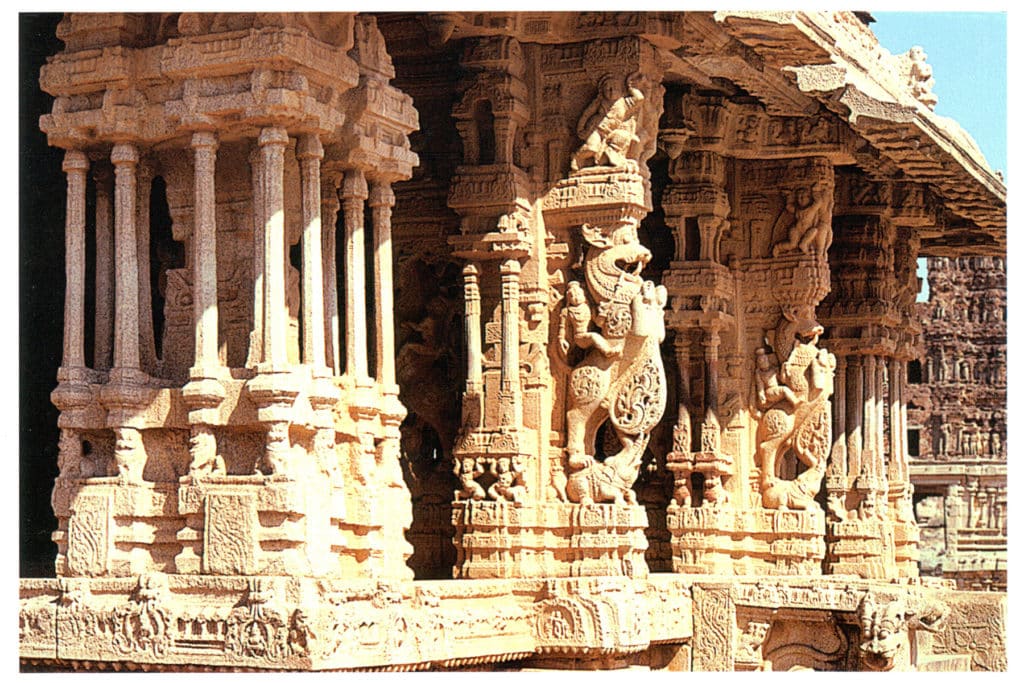
- Located in the Krishna-Tungabhadra basin.
- It was the nucleus of the Vijayanagara Empire (1336).
- No mortar or cementing agent was used in the construction of fortified walls and the technique followed was to wedge them together by interlocking.
- It got splendid arches, domes and pillared halls with niches for holding sculptures.
- During 15th – 16th centuries, Hampi bustled with commercial and cultural activities. Moors (a name used collectively for Muslim merchants), Chettis and agents of European traders such as the Portuguese, thronged the markets of Hampi.
- Temples were the hub of cultural activities and devadasis (temple dancers) performed before the deity, royalty and masses in the many-pillared halls in the Virupaksha (a form of Shiva) temple.
- Hampi fell into ruin following the defeat of Vijayanagara in 1565 by the Deccani Sultans – the rulers of Golconda, Bijapur, Ahmadnagar, Berar and Bidar.
Surat
- It was an emporium of western trade during the Mughal period along with Cambay (present Khambat).
- Surat was the gateway for trade with West Asia via the Gulf of Ormuz. Surat has also been called the gate to Mecca because many pilgrim ships set sail from here.
- In the 17th century the Portuguese, Dutch and English had their factories and warehouses at Surat.
- The textiles of Surat were famous for their gold lace borders (zari) and had a market in West Asia, Africa and Europe.
- Decline factors: the loss of markets and productivity, control of the sea routes by the Portuguese, competition from Bombay where the English East India Company shifted its headquarters in 1668.
Masulipatnam
- Lay on the delta of the Krishna river.
- Both the Dutch and English East India Companies attempted to control Masulipatnam.
- The fort at Masulipatnam was built by the Dutch.
- The Qutb Shahi rulers of Golconda imposed royal monopolies on the sale of textiles, spices and other items to prevent the trade passing completely into the hands of the various East India Companies.
- In 1686-1687 Mughal Emperor Aurangzeb annexed Golconda.
- So European Companies took alternatives to Bombay, Calcutta and Madras which lost Masulipatanam’s glory.
Join us, follow us....
Follow on Telegram – Click Here
Follow Whats apps Channel – Click Here
Join Google News Group – Click Here