Birsa Munda: The Tribal Freedom Fighter
Tribal leader and often referred to as Bhagwan, Birsa Munda, was a prominent icon during India's freedom struggle for the tribal population, here we have shared his biography for better understanding about his life and work.
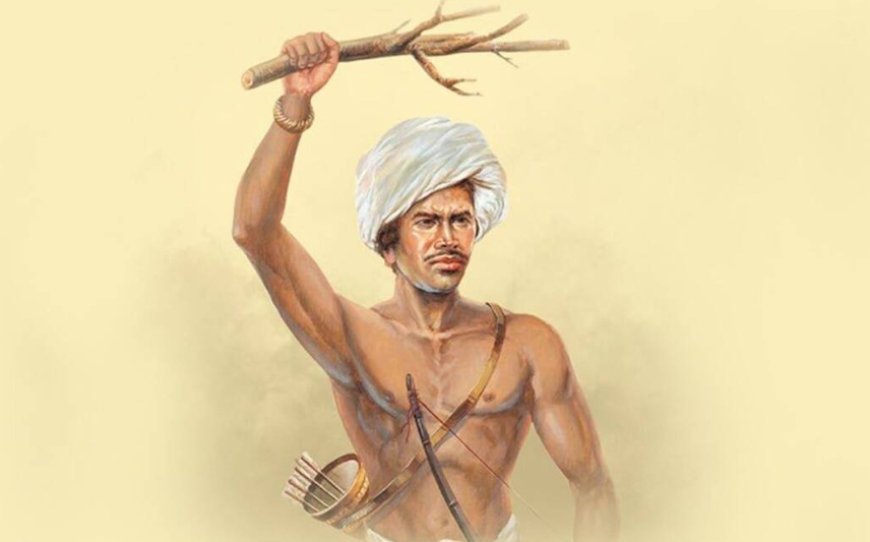
Who was Birsa Munda?
In Indian history, Birsa Munda is remembered as a highly respected leader who inspired tribal communities to fight for independence. He was born on November 15, 1875, in the Munda community, a significant cultural group in Jharkhand, in the village of Ulihatu near Ranchi. Birsa Munda emerged as an iconic figure in the resistance against British colonial rule and the injustices faced by tribal communities. Check the table provided below.
| Aspect | Details |
| Name | Birsa Munda |
| Date of Birth | November 15, 1875 |
| Place of Birth |
Ulihatu, near Ranchi, Jharkhand, India
|
| Tribe | Munda |
| Known For |
Freedom fighter and leader of the tribal people
|
| Activities |
Opposed British rule and led uprisings for tribal rights
|
| Death |
9 June 1900
|
Birsa Munda: Early Life
Birsa Munda was born on November 15, 1875, to Sugana Munda and Karmi Hatu in Ulihatu, Bengal Presidency (Present-day Jharkhand). He was born on Thursday, hence, as per Munda tribe customs, he was named after the day. Birsa Munda's family moved to Kurumbda and then to Bamba in search of the employment, either as labourers or crop-sharers.
Due to poverty, Birsa Munda was sent to his maternal uncle's village-- Ayubhatu. Munda lived at Ayubhatu for two years and was surrounded by Christian missionaries. These missionaries attacked the old Munda order and wanted to convert people into Christianity. At Ayubhatu, Birsa went to a missionary school and his teacher encouraged him to study further. He was advised by his teacher to enrol in German Mission School, but to get admitted, Munda was forced to convert to Christianity. He was renamed as Birsa David and later to Birsa Daud after the conversion. Birsa left the German Mission School after studying for a few years.
During 1886-1890 (the period of German and Roman Catholic Christian agitation), Birsa stayed at Chaibasa, but in the wake of freedom struggle, Munda's father withdrew him from school and left the place. The family also renounced Christianity and reverted to their original tribal religious customs.
On his temporary stay, Birsa found a suitable companion in the neighbourhood village Sankara. He presented her parents with jewels and explained the reasons behind his idea of marriage. However, on his return from jail, he didn't found her loyal and left her. The daughter of Mathura Muda (kept by Kali Munda) and wife of Jaga Munda insisted Birsa on becoming his wives, to which he rebuked. Sali from Burudih stayed with Munda for a long time. When Birsa Munda grew old, he stressed monogamy. Birsa was jailed due to a rumour that the people who will not follow Birasait would be massacred.
Birsa Munda and his new religion
Birsa Munda was also a founder of a new religion called Birsait. The religion believed in one God and encouraged them to revert to their original religious beliefs. People started referring to him as an economical religion healer, a miracle-worker and a preacher. People belonging to the tribe of Mundas, Oraons and Kharias moved together to visit the new prophet and to find a cure to their problems. People belonging to Oraon and Munda became convinced Birasaities. People started referring him Dharti Abba. Several contemporary and folk songs reveal his influence over the people of various tribes.
Birsa Munda not only preached the new religion but also mobilised people and formed the Guerrilla Army to end British Raj. His slogan threatening the British Raj is still remembered today in the states of Odisha, Bihar, West Bengal and Madhya Pradesh. The slogan was 'Abua raj seter jana, maharani raj tundu jana' which means 'Let the kingdom of the queen be ended and our kingdom will be established'.
Birsaits and their revolts
In the late 1890s, Birsa Munda abolished the feudal system introduced by the Britishers in the Adivasi forest. Under this system, migrants from other states were invited by the British to work over tribal lands and to pocket all the profits. This, in turn, deprived the owners of their proprietary rights over the land and were left with no means of livelihood. Thus, due to the agrarian breakdown and culture change, Birsa along with his tribe revolted.
In 1895, Birsa asked his fellow tribesman to renounce Christianity and guided them to worship one God and showed them the path of purity, austerity and prohibited cow- slaughters. He further claimed himself to be a prophet and stated that reign of Queen Victoria was over and the Munda Raj has begun. His followers declared that the British were their real enemies and not the Christian Mundas.
The followers of Birsa Munda started a series of attack on several places loyal to the British (police station, shops, etc.). They also killed two police constables, razed the houses of local shopkeepers, attacked commissioners and deputy commissioners. The British in return set a reward of Rs. 500 on Birsa Munda and sent an army of 150 people to crush the rebellion. The forces gheraoed the Guerrilla Army at Dumbari Hills and killed hundreds of people. Birsa managed to escape but was later on arrested and sent to jail.
During his trial in the prison, Birsa Munda died on June 9, 1900. The movement faded out after his death. Eight years after his death in 1908, the colonial government introduced the Chotanagpur Tenancy Act (CNT). This Act prohibited the transfer of tribal lands to non-tribals and protected the proprietary rights of the owners.
Birsa Munda’s Ulgulan
Birsa became a mass leader and began to be considered Bhagwan and Dharati Aba by his followers. He ignited the minds of the masses- the Mundas, Oraons, other Adivasis and non-Adivasis responded to his call and joined the “Ulgulan” (great tumult) or revolt against the colonial power and exploitative dikus (1899-1900).
Birsa asked the people not to pay any rent and attacked the outposts of feudal, missionary, and colonial authorities.
The tribals of Central and Eastern India waged an effective armed resistance against the British with traditional bows and arrows, but only the real exploiters were attacked, and the common people were not troubled.
Birsa Munda was captured by British police and lodged in jail at the age of 25, where he died in captivity on June 9, 1900.
But Bhagwan Birsa Munda’s spirited struggle did not go in vain as it compelled the British to take action on the plight and exploitation of tribals, which resulted in the Chhota Nagpur Tenancy Act of 1908 for their protection.
This Act restricted the transfer of tribal land to non-tribals and became landmark legislation for the protection of tribal rights. The British regime also took steps to abolish Veth Bigari or forced labor.
Soon after his death, the movement died, but fact remains that he was the one to mobilize the tribal community against the British and forced the colonial authorities to introduce laws protecting the land rights of the tribals.
Other tribal uprisings against colonial rule:
Pahariya rebellion (1778)
This took place in Raj mahal hills (present-day Jharkhand) against the British encroachment on tribal lands. The rebellion forced the East India Company to declare their territory autonomous, which was later known as the “Daman-i-Koh” area.
Chuar uprising/ Revolt of the jungle mahal (1766-72 and 1795-1816)
Chuars were the aboriginal tribes of jungle mahal (present-day West Bengal) and they also stood up to English encroachments in their territory.
Khasi revolt (1829)
The Khasis revolted against the construction of a road from Brahmaputra valley to Sylhet by EIC, because this project increased the inflow of outsiders, threatening their tribal autonomy.
Kol mutiny (1831)
The Kols of the Chhota Nagpur area protested against their lands being transferred to outsiders by the English to increase the land revenue.
Khond uprisings (1837-56)
The Khond, Gumsar, and Kalahandi tribes of eastern ghats (present-day Odisha and Andhra Pradesh) rose against the attempt by the government to suppress human sacrifice (Mariah), the introduction of new taxes by the British, and the influx of Zamindars and sahookars (money-lenders) into their area.
Bhils and Koli uprising (1817-48)
The Bhils were concentrated in the hill ranges of Khandesh in the Maratha territories of Gujarat, Rajasthan, and Madhya Pradesh. British occupation of this region in 1818 brought in the outsiders who dislocated the local community life. Similarly, the Kolis of Ahmednagar district, also challenged the British in 1829 but were quickly subdued by a large army contingent.
Ramosi uprising (1822-41)
Ramosis were the hill tribes of western ghats who were recruited as soldiers in the Maratha army. The main cause of the uprising was their disbanding by the British after the decline of Marathas. The British later pacified the movement by taking them into their armies.
Santhal revolt/ Santhal hool (1855-56)
The Santhal, who lived in the area between Bhagalpur and Rajmahal, known as Daman-i-Koh, rose in revolt; made a determined attempt to expel the outsiders (the dikus), and proclaimed the complete end of the foreign regime. The Santhal Paragana tenancy act of 1876 finally made it illegal to transfer Santhal land to a non- Santhal.
Rampa rebellion (1922)
The Rampa Rebellion against the British was organized by the tribal people of Visakhapatnam and East Godavari districts to revolt against the foreigners’ encroachment on their lands.
India’s freedom struggle was strengthened by several tribal communities such as Mundas, Oraons, Santhals, Tamars, Kols, Bhils, Khasis, Koyas, and Mizos, to name a few. The revolutionary movements and struggles organized by tribal communities were marked by their immense courage and supreme sacrifice and inspired Indians all over the country.
The government of India is now making sure that the sacrifices of such tribal movements and their leaders are not lost in history.
Birsa Munda and his legacy
Birsa Munda's legacy is still alive and tribal peoples of Karnataka and Jharkhand celebrate his birth anniversary on November 15. Many institutions and organizations-- Birsa Agricultural University, Birsa Institute of Technology, Birsa College Khunti, Birsa Institute of Technology Sindri, Sidho Kanho Birsha University, Birsa Munda Athletics Stadium, Birsa Munda Airport, Birsa Munda Central Jail, Birsa Seva Dal, Birsa Munda Tribal University-- are named after him.
In 2004, Ashok Saran made a Hindi film 'Ulgulan-Ek Kranti' and 500 Birsaits appeared as extras in the movie. In 2008, another film 'Gandhi se Pehle Gandhi' based on the novel on the life of Birsa Munda and was directed by Iqbal Saran (author of the novel).
Mahasweta Devi wrote a novel 'Aranyer Adhikar' on the life of Birsa Munda and his rebellion against British Raj. The novel won her the Sahitya Akademi Award for Bengali in 1979.
150-foot-tall Statue of Ulgulan (Birsa Munda) is proposed to be built in Jharkhand. The stones to be used in the statue are collected from the local houses of the area.
Birsa Munda Jayanti
Birsa Munda Jayanti, celebrated annually on November 15th, is a significant occasion in India, particularly in the state of Jharkhand. This day commemorates the birth anniversary of Birsa Munda, a revered tribal leader and freedom fighter who dedicated his life to the welfare of tribal communities and their struggle against British colonial oppression. On this day, people from diverse backgrounds unite to honor Birsa Munda’s contributions to the Indian freedom movement and the preservation of tribal culture.
Various events, cultural activities, and discussions are organized to pay tribute to Birsa Munda’s enduring legacy. Celebrating Birsa Munda Jayanti reminds us of the importance of tribal rights, social justice, and the need to protect and cherish the rich cultural heritage of indigenous communities in India. It is a day for reflection, inspiration, and renewed commitment to the values that Birsa Munda championed.
Bhagwan Birsa Munda
Birsa Munda is commonly referred to as ‘Dharti Aba,’ which translates to ‘Earth Father.’ Some of his devotees consider him a deity and offer him worship. However, not everyone uses this title. For many, it serves as a means of demonstrating respect and commemorating his significant contributions. In essence, Birsa Munda is a revered and heroic figure within the tribal communities of Jharkhand. He symbolizes their resistance against the British and their quest for justice and rights in India’s historical context.
Birsa Munda Airport Ranchi
Birsa Munda Airport is in Ranchi, the capital of Jharkhand in India. It’s named after Birsa Munda, a tribal hero who fought against the British long ago. The airport is managed by the Airports Authority of India and handles flights from within the country and abroad.
There’s one building for arriving and departing passengers at the airport. It has useful things like Wi-Fi, ATMs, baggage carts, and a food court. The airport can welcome more than 1 million passengers every year.
Birsa Munda Park
Birsa Munda Park, situated in Ranchi, Jharkhand, India, is a big 400-acre place for fun and relaxation. It’s named after Birsa Munda, a tribal leader who bravely opposed the British in the late 19th century. The park has lots to do for everyone, with a large lake for boating and water fun. There are walking and jogging paths, as well as cycling trails for those who love the outdoors.
For those who like excitement, the park has rides like a big wheel, a roller coaster, and a toy train. There’s also a special play area for kids with swings, slides, and other fun activities.
Birsa Munda History
Birsa Munda, a revered leader of the Munda tribe, introduced a novel religion known as “Birsait” to reform tribal society. Proclaiming himself as the messenger of God, Birsa garnered widespread support from the Kharias, Orans, and Munda tribal communities, as well as significant interest from Hindus and Muslims. His leadership drew large crowds, urging tribal people to shun missionary activities and embrace their traditional customs and beliefs once again.
- Birsa Munda, a prominent leader of the Munda tribe, initiated the “Birsait” religion to reform tribal society.
- Declaring himself as God’s messenger, Birsa gained followers from various tribal communities and attracted interest from Hindus and Muslims.
- Large gatherings ensued as people flocked to witness the emergence of this new religious movement.
- Birsa advocated for a return to traditional practices and urged tribal people to disregard missionary activities.
Important Facts about Birsa Munda
- Birsa Munda spearheaded a rebellion against the British Raj in the late 19th century, rallying the Mundas and other tribes to resist colonial rule and engaging in battles against the British forces.
- Known for his slogan “Abua raj seter jana, maharani raj tundu jana” (Let the rule of the whites be ended and our raj come).
- Arrested in 1895, Birsa Munda spent several years in prison until he died in 1900.
- Celebrated as a hero and a symbol of tribal resistance in India, Birsa Munda’s legacy is honoured in literature, music, and art.
- The Birsa Munda Airport in Ranchi, Jharkhand is named in his honour.
- Jharkhand observes a state holiday on November 15 to celebrate Birsa Munda’s birth anniversary.
- Birsa Munda’s influence extends to various tribal movements across India, and his principles of social justice and equality continue to inspire people today.
Join us, follow us....
Follow on Telegram – Click Here
Follow Whats apps Channel – Click Here
Join Google News Group – Click Here