Rabindranath Tagore: Biography
Rabindranath Tagore Jayanti 2023: He was a great scholar, novelist, essayist, song composer, and playwright. Rabindranath Tagore Jayanti marks the birth anniversary of the famous writer Rabindranath Tagore. He was born on 7 May, 1861. Let us read more about Rabindranath Tagore, his early life, childhood days, works, family, awards, and achievements.
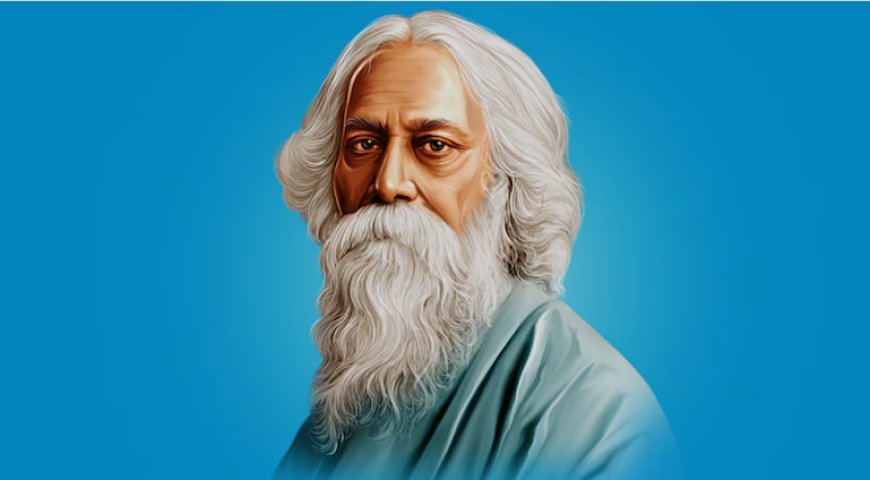
Rabindranath Tagore Jayanti 2023: The birth anniversary of Rabindranath Tagore is observed on May 7, according to the Gregorian calendar but according to the Bengali calendar, he was born on the 25th day of Boishakh month. So, in West Bengal, his birthday, as per the Bengali calendar, is being celebrated this year on 9 May. In the article below, learn all about Tagore's early life, his family, education, career and more.
Rabindranath Tagore's birth anniversary is also known as Pochishe Boishakh. He was born in a rich Brahmin family in Kolkata (Calcutta) and was the youngest sibling in his family.
Born: 7 May, 1861
Place of Birth: Calcutta, British India
Penname: Bhanu Singha Thakur (Bhonita)
Father: Debendranath Tagore
Mother: Sarada Devi
Spouse: Mrinalini Devi
Children: Renuka Tagore, Shamindranath Tagore, Meera Tagore, Rathindranath Tagore, and Madhurilata Tagore
Died: 7 August, 1941
Place of Death: Calcutta, British India
Profession: Writer, song composer, playwright, essayist, painter
Language: Bengali, English
Award: Nobel Prize in Literature (1913)
Let us tell you that Rabindranath Tagore was a multi-talented personality with a great desire to learn new things. His contributions to literature, music and several other works are unforgettable. People not only in West Bengal but also in the whole of India remember him and his contributions on his birth anniversary. Even in 1913, he was awarded the most prestigious Nobel Prize for his great contribution to Indian literature. Do you know that he was the first person from Asia to receive this award? We can't forget that he is the person who composed the National Anthem of India.
The early life of Rabindranath Tagore
Rabindranath Tagore was born on 7th May 1861 in Calcutta as the youngest son of Debendranath Tagore and Sarada Devi.
His grandfather Dwarkanath Tagore was a rich landlord and social reformer. His father, Debendranath Tagore was a leader of the Brahmo Samaj, a new religious sect in nineteenth-century Bengal which attempted a revival of the ultimate monistic basis of Hinduism as laid down in the Upanishads.
The Tagore family was a treasure trove of talent in every field. They hosted the publication of literary magazines; theatre and recitals of Bengali and Western classical music featured there regularly. Tagore’s father invited several professional musicians to stay in the house and teach Indian Classical music to the children.
Tagore’s oldest brother Dwijendranath was a philosopher and poet. Another brother, Satyendranath, was the first Indian appointed to the formerly all-European Indian Civil Service. Another brother, Jyotitindranath, was a musician, composer, and playwright. His sister Swarnakumari became a novelist.
Education
Rabindra Nath Tagore had his initial education in Oriental Seminary School. But he did not like the conventional education and started studying at home under several teachers. He was mostly trained by his siblings both in literary as well as physical activities like gymnastics and martial arts.
Tagore was a child prodigy when it comes to writing as he has started writing and publishing poetry by the age of eight.
In 1873, at the age of eleven, Tagore and his father left Calcutta to tour India for several months. He visited his father’s Santiniketan estate and Amritsar before reaching the Himalayan hill station of Dalhousie where he read biographies, studied history, astronomy, modern science, and Sanskrit, and examined the classical poetry of Kalidasa.
At the age of seventeen, he was sent to England for formal law schooling but he did not finish his studies there. He rather took up independent studies of Shakespeare.
He returned from England in 1880 and regularly published poems, stories, and novels in Bengali, slowly starting to transform Bengali literature.
In 1883, he married Mrinalini Devi, a child bride as was the tradition in those times.
Rabindranath Tagore: Established Shantiniketan
His father bought a huge land for meditation and named it Shantiniketan. Debendranath Tagore founded an 'Ashram' in 1863. In 1901, Rabindranath Tagore established an open-air school. It was a prayer hall with marble flooring and was named 'The Mandir'. It was also named 'Patha Bhavana' and started with only five students. Classes here were held under trees and followed the traditional Guru-Shishya method of teaching. This trend of teaching revived the ancient method of teaching, which proved beneficial when compared with the modernised method. Unfortunately, his wife and two children died and he left alone. At that time, he was very disturbed. In the meantime, his works started growing and became more popular among Bengali as well as foreign readers. In 1913, he gained recognition, was awarded the prestigious Nobel Prize in Literature, and became Asia's first Nobel Laureate. Shantiniketan is now a famous University town in West Bengal.
Let us tell you that Rabindranath Tagore envisioned a centre of learning which would have the best of both the east and the west. He established the Visva Bharati University in West Bengal. It consists of two campuses, one at Shantiniketan and the other at Sriniketan. Sriniketan focuses on agriculture, adult education, village, cottage industries, and handicrafts.
Rabindranath Tagore: Literary Works
Japajog: Published in 1929, His novel is a compelling take on marital rape.
Nastanirh: Published in 1901. This novel is about relationships and love, both requited and unrequited.
Ghare Baire: Published in 1916. It is a story about a married woman constricted in her household trying to find her own identity.
Gora: In the 1880s, it is an expansive, exhaustive, and extremely relevant novel that deals with several themes like religion, gender, feminism, and also tradition against modernity.
Chokher Bali: In 1903, a novel which consists of various facets of relationships.
His short stories are Bhikarini, Kabuliwala, Kshudita Pashan, Atottju, Haimanti and Musalmanir Golpo etc.
Poems are Balaka, Purobi, Sonar Tori and Gitanjali.
No doubt he has changed the dimensions of Bengali literature as it was earlier viewed. Many countries have even erected statues to pay tribute to the legendary writer. Around five museums are dedicated to Tagore, of which three are situated in India and the remaining two in Bangladesh.
He spent his last years in severe pain and even in 1937, he went into a comatose condition. After a lot of suffering, he died on August 7, 1941, in the Jorasanko mansion where he was brought up.
Rabindranath Tagore in Independence movement
Tagore participated in the Indian nationalist movement from time to time, though in his own non-sentimental and visionary way; and Gandhi, the political father of modern India, was his devoted friend. Tagore came to be recognized as one of the architects of modern India.
India’s first Prime Minister, Jawaharlal Nehru, wrote in Discovery of India, “Tagore and Gandhi have undoubtedly been the two outstanding and dominating figures in the first half of the twentieth century. Tagore’s influence over the mind of India, and especially of successive rising generations has been tremendous. Not Bengali only, the language in which he wrote, but all the modern languages of India have been molded partly by his writings. More than any other Indian, he has helped to bring into harmony the ideals of the East and the West, and broadened the bases of Indian nationalism.”
In 1905, Viceroy Curzon decided to divide Bengal into two parts. Rabindranath Tagore strongly protested against this decision. Tagore wrote many national songs and attended protest meetings. He initiated the Rakhibandhan ceremony, symbolizing the underlying unity of undivided Bengal.
In 1919, following the Jallianwala Bagh massacre, Tagore renounced his knighthood condemning the act. He was a supporter of Gandhiji but he stayed out of politics. He was opposed to nationalism and militarism as a matter of principle, and instead promoted spiritual values and the creation of a new world culture founded in multi-culturalism, diversity, and tolerance.
Tagore the educationalist
1n 1921, Rabindranath Tagore established Viswabharati University and gave all his money from Nobel Prize and royalty money from his books to this University.
Tagore was quite knowledgeable of Western culture, especially Western poetry and sciences. Tagore had a good grasp of modern – post-Newtonian – physics and was well able to hold his own in a debate with Einstein in 1930 on the newly emerging principles of quantum mechanics and chaos. His meetings and tape-recorded conversations with his contemporaries such as Albert Einstein and H.G. Wells, epitomize his brilliance.
In 1940 Oxford University arranged a special ceremony in Santiniketan and awarded Rabindranath Tagore with a Doctorate of Literature.
Death
After an extended period of suffering, Tagore died on August 7, 1941, in the same mansion in which he was brought up.
Legacy of Rabindranath Tagore:
Rabindranath Tagore changed the way Bengali literature was perceived as he left an everlasting impression on the readers.
Many countries have his statues erected and host many yearly events to pay tribute to the legendary writer.
Many of his works have been made global, thanks to a host of translations by many famous international writers.
There are five museums dedicated to Tagore. While three of them are situated in India, the remaining two are in Bangladesh. The museums’ house his famous works, and are visited by millions every year.
Join us, follow us....
Follow on Telegram – Click Here
Follow Whats apps Channel – Click Here
Join Google News Group – Click Here