Medieval India: Delhi Sultanate (NCERT)
Medieval India: Delhi Sultanate (NCERT)

Delhi: The centre of attraction
When did Delhi become strategically important as a centre of political importance? Who were the major rulers of Delhi during the medieval period? Hopefully, you will get answers to these questions in this post.
- Delhi became an important city only in the 12th century.
- Delhi first became the capital of a kingdom under the Tomara Rajputs, who were defeated in the middle of the twelfth century by the Chauhans.
Rajput Dynasty
- Tomaras [early twelfth century – 1165]
- Ananga Pala [1130 -1145]
- Chauhans [1165 -1192]
- Prithviraj Chauhan [1175 -1192]
Delhi Sultans
- By the 13th century, Sultanates transformed Delhi into a capital that controlled vast areas of the subcontinent.
- “Histories”, tarikh (singular) / tawarikh (plural), written in Persian, the language of administration under the Delhi Sultans by learned men: secretaries, administrators, poets and courtiers who lived in cities (mainly Delhi) and hardly ever in villages.
- Objectives of these writings : (a) They often wrote their histories for Sultans in the hope of rich rewards (b) they advised rulers on the need to preserve an “ideal” social order based on birthright and gender distinctions (c) their ideas were not shared by everybody.
- In 1236 Sultan Iltutmish’s daughter, Raziyya, became Sultan. Nobles were not happy at her attempts to rule independently. She was removed from the throne in 1240.
Early Turkish [1206-1290]
- Qutbuddin Aybak [1206 -1210]
- Shamsuddin Iltutmish [1210 -1236]
- Raziyya [1236 -1240]
- Ghiyasuddin Balban [1266 -1287]
The expansion of the Delhi Sultanate
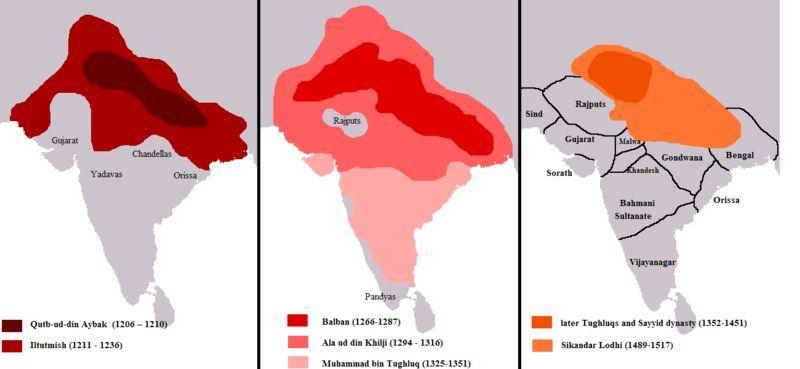
- In the early 13th century the control of the Delhi Sultans rarely went beyond heavily fortified towns occupied by garrisons.
- The Sultans seldom controlled the hinterland, the lands adjacent to a city or port that supplied it with goods and services, of the cities and were therefore dependent upon trade, tribute or plunder for supplies.
- Controlling garrison towns in distant Bengal and Sind from Delhi was extremely difficult.
- The state was also challenged by Mongol invasions from Afghanistan and by governors who rebelled.
- The expansion occurred during the reigns of Ghiyasuddin Balban, Alauddin Khalji and Muhammad Tughluq.
Khalji Dynasty [1290 – 1320]
- Jalaluddin Khalji [1290 – 1296]
- Alauddin Khalji [1296 -1316]
Tughluq Dynasty [1320 – 1414]
- Ghiyasuddin Tughluq [1320-1324]
- Muhammad Tughluq [1324 -1351]
- Firuz Shah Tughluq [1351 -1388]
- So, the first thing Sultans did was consolidate these hinterlands of the garrison towns. During these campaigns forests were cleared in the Ganga-Yamuna doab and hunter-gatherers and pastoralists were expelled from their habitat.
- These lands were given to peasants and agriculture was encouraged. New fortresses and towns were established to protect trade routes and to promote regional trade.
- Secondly, expansion occurred along the “external frontier” of the Sultanate. Military expeditions into southern India started during the reign of Alauddin Khalji and culminated with Muhammad Tughluq.
Administration & Consolidation
- Rather than appointing aristocrats as governors, the early Delhi Sultans, especially Iltutmish, favoured their special slaves purchased for military service, called bandagan .
- The Khaljis and Tughluqs continued to use bandagan and also raised people of humble birth, who were often their clients, to high political positions.
- Slaves and clients were loyal to their masters and patrons, but not to their heirs.
- Authors of Persian tawarikh criticised the Delhi Sultans for appointing the “low and base-born” to high offices.
- Military commanders were appointed as governors of territories. This land is called iqta and their holder is called iqtadar or muqti . The duty of muqti was to lead military campaigns and maintain law and order in their iqtas.
- But still large parts of the subcontinent remained outside the control of the Delhi Sultans.
- The Mongols under Genghis Khan invaded Transoxiana in north-east Iran in 1219 and the Delhi Sultanate during the reign of Alauddin Khalji and Muhammad Tughluq.
A.Khalji’s defensive policy against Genghis
- As a defensive measure, Alauddin Khalji raised a large standing army.
- Constructed a new garrison town named Siri for his soldiers.
- In order to feed soldiers, produce was collected as tax from lands, and paddy had got fixed tax of 50% of the yield.
- Alauddin chose to pay his soldiers’ salaries in cash rather than iqtas. He made sure merchants sold supplies to these soldiers according to prescribed prices.
- So here A.Khalji’s administrative measures were highly praised due to effective intervention in markets to have prices under control.
- He successfully withstood the threat of Mongol invasions.
M.Tughluq’s offensive policy against Genghis
- The Mongol army was defeated earlier. M.Tughluq still raised a large standing army.
- Rather than constructing a new garrison town, he emptied the residents of a Delhi city named Delhi-i Kuhna and the soldiers garrisoned there.
- Produce from the same area was collected as tax and additional taxes to feed the large army. This coincided with famine in the area. .
- Muhammad Tughluq also paid his soldiers cash salaries. But instead of controlling prices, he used a “token” currency. This cheap currency could be counterfeited easily because it was made of “bronze”.
- His campaign in Kashmir was a disaster. He then gave up his plans to invade Transoxiana and disbanded his large army.
- His administrative measures created complications. The shifting of people to Daulatabad was resented. The raising of taxes and famine in the Ganga-Yamuna belt led to widespread rebellion. And finally, the “token” currency had to be recalled.
15th & 16th Century Sultanates: Sayyid, Lodi and Suri
Sayyid Dynasty [1414 – 1451]
- Khizr Khan 1414 -1421
Lodi Dynasty [1451 – 1526]
- Bahlul Lodi 1451 -1489
Suri Dynasty [1540-1555]
- Sher Shah Suri [1540-1545] captured Delhi.
- For the first time during the Islamic conquest the relationship between the people and the ruler was systematized, with little oppression or corruption.
- He challenged and defeated the Mughal emperor Humayun (1539 : Battle of Chausa, 1540 : Battle of Kannauj)
- Sher Shah introduced an administration that borrowed elements from Alauddin Khalji and made them more efficient.
- Sher Shah’s administration became the model followed by the great emperor Akbar (1556-1605) when he consolidated the Mughal Empire.
- His tomb is at Sasaram [Bihar]
Delhi sultanate, principal Muslim sultanate in north India from the 13th to the 16th century. Its creation owed much to the campaigns of Muʿizz al-Dīn Muḥammad ibn Sām (Muḥammad of Ghūr; brother of Sultan Ghiyāth al-Dīn of Ghūr) and his lieutenant Quṭb al-Dīn Aibak between 1175 and 1206 and particularly to victories at the battles of Taraōrī in 1192 and Chandawar in 1194.
The Ghūrid soldiers of fortune in India did not sever their political connection with Ghūr (now Ghowr, in present Afghanistan) until Sultan Iltutmish (reigned 1211–36) had made his permanent capital at Delhi, had repulsed rival attempts to take over the Ghūrid conquests in India, and had withdrawn his forces from contact with the Mongol armies, which by the 1220s had conquered Afghanistan. Iltutmish also gained firm control of the main urban strategic centres of the North Indian Plain, from which he could keep in check the refractory Rajput chiefs. After Iltutmish’s death, a decade of factional struggle was followed by nearly 40 years of stability under Ghiyāth al-Dīn Balban, sultan in 1266–87. During this period Delhi remained on the defensive against the Mongols and undertook only precautionary measures against the Rajputs.
Under the sultans of the Khaljī dynasty (1290–1320), the Delhi sultanate became an imperial power. ʿAlāʾ al-Dīn (reigned 1296–1316) conquered Gujarat (c. 1297) and the principal fortified places in Rajasthan (1301–12) and reduced to vassalage the principal Hindu kingdoms of southern India (1307–12). His forces also defeated serious Mongol onslaughts by the Chagatais of Transoxania (1297–1306).
Muḥammad ibn Tughluq (reigned 1325–51) attempted to set up a Muslim military, administrative, and cultural elite in the Deccan, with a second capital at Daulatabad, but the Deccan Muslim aristocracy threw off the overlordship of Delhi and set up (1347) the Bahmanī sultanate. Muḥammad’s successor, Fīrūz Shah Tughluq (reigned 1351–88), made no attempt to reconquer the Deccan.
The power of the Delhi sultanate in north India was shattered by the invasion (1398–99) of Turkic conqueror Timur (Tamerlane), who sacked Delhi itself. Under the Sayyid dynasty (c. 1414–51) the sultanate was reduced to a country power continually contending on an equal footing with other petty Muslim and Hindu principalities. Under the Lodī (Afghan) dynasty (1451–1526), however, with large-scale immigration from Afghanistan, the Delhi sultanate partly recovered its hegemony, until the Mughal leader Bābur destroyed it at the First Battle of Panipat on April 21, 1526. After 15 years of Mughal rule, the Afghan Shēr Shah of Sūr reestablished the sultanate in Delhi, which fell again in 1555 to Bābur’s son and successor, Humāyūn, who died in January 1556. At the Second Battle of Panipat (November 5, 1556), Humāyūn’s son Akbar definitively defeated the Hindu general Hemu, and the sultanate became submerged in the Mughal Empire.
The Delhi sultanate made no break with the political traditions of the later Hindu period—namely, that rulers sought paramountcy rather than sovereignty. It never reduced Hindu chiefs to unarmed impotence or established an exclusive claim to allegiance. The sultan was served by a heterogeneous elite of Turks, Afghans, Khaljīs, and Hindu converts; he readily accepted Hindu officials and Hindu vassals. Threatened for long periods with Mongol invasion from the northwest and hampered by indifferent communications, the Delhi sultans perforce left a large discretion to their local governors and officials.
Join us, follow us....
Follow on Telegram – Click Here
Follow Whats apps Channel – Click Here
Join Google News Group – Click Here